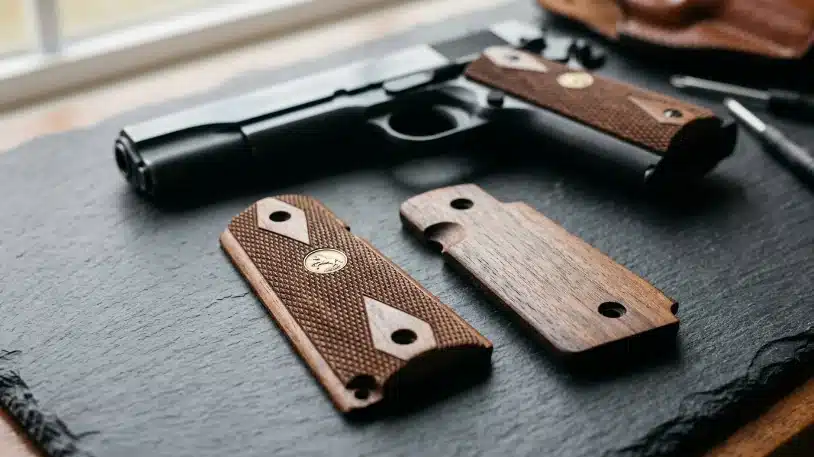
If your 1911 has a thumb safety on both sides, you’re shopping for 1911 ambi safety grips, grips with a small relief cut on the right panel so the extra safety lever clears the wood. Not every 1911 needs that cut, though. Some do, some don’t, and a few need a special version of it. This guide shows you how to tell which one you need, so you order the right set the first time and it drops straight on.
We’ve fitted and shipped a lot of 1911 grips over the years. One of the most common fitment mistakes we see is a right panel that fouls an ambi safety. It’s an easy one to avoid once you know what to look for.
What is an ambi safety cut?
An ambi safety cut is a small notch on the back top corner of the right grip panel, just behind the top screw. It gives the right-side safety lever room to move up and down without rubbing the wood.
A standard 1911 has its thumb safety on the left side only. The right grip panel sits flush, no cut needed. An ambidextrous safety adds a second lever on the right side of the frame. That lever needs clearance. That clearance is the cut.
So when a listing says ambi safety cut grips 1911, it just means the right panel already has that notch machined in.
Do you need an ambi cut on your 1911 grips?
Here’s the part most guides get wrong. Whether you need the cut doesn’t depend on having an ambi safety. It depends on how that safety is held in place.
There are two designs:
Colt-style ambi safety. The right lever has a small leg, or paddle, that tucks under the grip panel. The panel actually helps hold the lever on the gun. With this design, an uncut panel will bind against the leg and stop the safety from working right. You need an ambi cut.
Kimber / King’s / Rock Island-style ambi safety. The right lever is held by a pinned or dovetailed sear pin, not the grip. The panel isn’t doing any retaining work. In theory you don’t need a cut here. In practice, a tall right panel can still foul the lever at the top, so you may need to trim a hair off the edge.
Quick test: pull your right grip panel off and look. If the safety lever has a leg sitting under where the panel goes, you need the cut. If the lever is held by a pin and the panel sits clear of it, you likely don’t.
When in doubt, get the cut. A cut panel works fine on a gun that doesn’t strictly need one. The reverse is not true.
The different types of ambi safety cuts
Not all ambi cuts are the same shape. Ordering the wrong style is the second most common fitment slip-up. Match the cut to your gun’s maker:
| Your 1911 | Ambi cut you need |
|---|---|
| Most standard 1911s and clones | Standard ambi cut |
| Rock Island Armory | Rock Island ambi cut |
| STI / Staccato or Taurus | Extended ambi cut |
| Dan Wesson Specialist | DW Specialist cut |
| Kimber (factory ambi safety) | Usually no special cut |
Rock Island, STI, and Taurus levers sit differently than a standard Colt-pattern lever, so the notch is positioned or sized for them. A Kimber factory ambi safety uses the pinned design, so most Kimber owners don’t need any special cut at all, unless the gun has an aftermarket safety swapped in.
If you’ve changed your safety, ignore the factory rule and check the lever design instead.
Ambi cut grips with no ambi safety — does it matter?
A lot of grips ship with the ambi notch already cut, even budget sets. If your gun has a left-side safety only, that notch will just sit there empty on the right panel.
It does nothing harmful. A properly fitted cut sits in a low-stress spot and doesn’t weaken the grip or change how the gun runs. Some shooters just don’t love the look of an open slot on a single-safety gun. If that’s you, look for grips listed without the cut, or pick a panel where the slot is barely visible. Function-wise, it makes no difference.
One thing to watch on factory cuts: many are over-cut. The recess is made large so it clears every lever, which can leave the offside lever a little loose. That’s a problem with a sloppy cut, not the cut itself. If you ride your safety hard with your thumb, a tighter, properly sized cut holds better.
Can you cut your own grips for an ambi safety?
Yes, and it’s not hard on wood or ABS panels. G10 is a different story. It comes either cut or uncut from the maker, and it’s much harder to notch cleanly at home, so we’d order G10 grips already cut for your ambi safety rather than modify them. Pearl is the same — leave that one to a machine.
The short version: put the panel on the gun, work the safety to its full up and down positions, and mark where the lever travels. File a shallow slot along that path with a narrow file. Then ease a little material off the underside with a Dremel and a small stone. Go slow.
The mistake to avoid is cutting too deep. On Colt-style safeties, too much material lets the right lever work loose over time. A few thousandths of clearance is plenty. Less is more here.
For most people it’s not worth the risk on a nice set of grips. Buying the correct cut from the start is cleaner and cheaper than a ruined panel.
Picking the right ambi safety grips for your frame
Once you know your cut, the last step is frame size. The cut and the size are two separate choices.
Measure center to center between your grip screw holes. 3 1/16 inches (78 mm) apart means you want 1911 full size grips — that covers Government and Commander frames. 2 11/16 inches (68 mm) apart means you need 1911 compact size Grips for Officer and Defender frames.
From there it’s down to material and look. Browse the full range of 1911 Grips by frame and finish, and check each listing for the ambi cut and screw details before you buy.
All of our Custom Gun Grips are cut for a specific frame and ship as a drop-in fit, most with hardware included.
If you want a hand matching your exact gun and safety to the right set, reach out — the team at Premium Grips fits these every day and would rather point you to the correct panel than process a return.
Frequently asked questions
What does ambi safety cut mean on 1911 grips?
It means the right grip panel has a small notch behind the top screw. That notch gives an ambidextrous thumb safety lever room to move. Grips listed as having the cut are ready for a gun with a safety on both sides.
Do I need ambi cut grips if my 1911 has a safety on both sides?
Usually yes, but it depends on the safety design. Colt-style levers have a leg held by the grip, so they need the cut. Kimber, King’s, and Rock Island-style levers are pin-held and may not. Pull the right panel and look at how the lever is retained.
Can I put ambi cut grips on a 1911 with only one safety?
Yes. The empty notch does no harm and doesn’t affect the gun. It’s purely a cosmetic preference. If you don’t like the open slot, choose grips without the cut.
Which ambi cut do I need for a Rock Island 1911?
A Rock Island ambi cut. Rock Island levers sit differently than standard Colt-pattern levers, so a standard cut won’t line up correctly. STI, Staccato, and Taurus need an extended ambi cut instead.
Will an ambi cut weaken my grips?
No. A properly fitted notch is small and sits in a low-stress area of the panel. It won’t crack or loosen a well-made grip, and it has no effect on how the pistol functions. The only issue comes from a sloppy, over-cut recess, which is a cutting problem, not the cut itself.
How do I know if I need full size or compact grips?
Measure between the grip screw holes, center to center. 3 1/16 inches means full size (Government and Commander). 2 11/16 inches means compact (Officer and Defender).
The bottom line
Buying 1911 ambi safety grips comes down to two checks: does your safety design need the cut, and which version of the cut your gun’s maker uses.
Get those right and the panels drop straight on. Pull your right grip, look at the lever, match the cut to the table above, then pick your frame size and finish. When you’re ready, browse the full lineup and find a set built for your exact 1911.