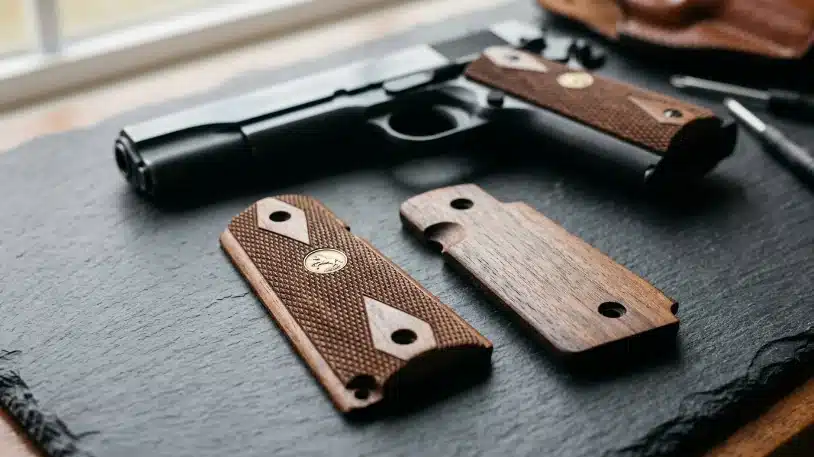
You finally found a grip set that looks perfect. Right material, right style, right price. You order it, wait for the package, tear it open, and it doesn’t fit. The screw holes are off by half an inch. The panel hangs below the frame. Or it doesn’t even reach the bottom.
That’s not bad luck. That’s a fitment problem. And it happens constantly in the 1911 world because people assume all 1911s are built the same. They’re not.
The debate around 1911 full size vs. compact grips isn’t just about looks or preferences. It’s about whether the grip panel you choose will actually seat correctly on your specific frame. Get it right and your pistol feels like an extension of your hand.
This guide settles the confusion for good. By the end, you’ll know exactly how full size and compact grips differ, which one fits your pistol, and how to make sure you never buy the wrong set again.
The 1911 Platform Is Not One Gun
Here’s the context most buyers are missing when they type “1911 grips” into a search bar.
The 1911 has been in continuous production for well over a century. In that time, it has been manufactured by hundreds of companies, chambered in multiple calibers, and built across three distinct frame sizes. Colt alone has made Government Models, Commanders, Officers, and Defenders. Then you’ve got Springfield, Kimber, Ruger, Rock Island Armory, Tisas, Dan Wesson, all building their own versions of the same platform.
The result? A massive family of pistols that share the same general design but don’t always share the same grip dimensions.
When you’re shopping for 1911 gun grips, you’re really choosing between two specific grip frames, the Government/Commander frame and the Officer/Compact frame. Those two frames have different heights, different grip panel proportions, and critically, different 1911 grip screw spacing. That last detail is what determines whether a grip physically fits your pistol or not.
What Are Full Size 1911 Grips?
Full size grips are built for the Government Model frame, the original 1911 design with a 5-inch barrel.
The Government Model is what most people picture when they think of a 1911. Long slide, full-length grip frame, and enough real estate to wrap all four fingers comfortably around the panel. It’s the pistol that went to war, came home, and never left American gun culture.
The Commander shares this same grip frame despite having a shorter 4.25-inch barrel. So when people talk about full size 1911 grips, they’re covering both Government and Commander frames, same grip dimensions, just different barrel lengths sitting on top.
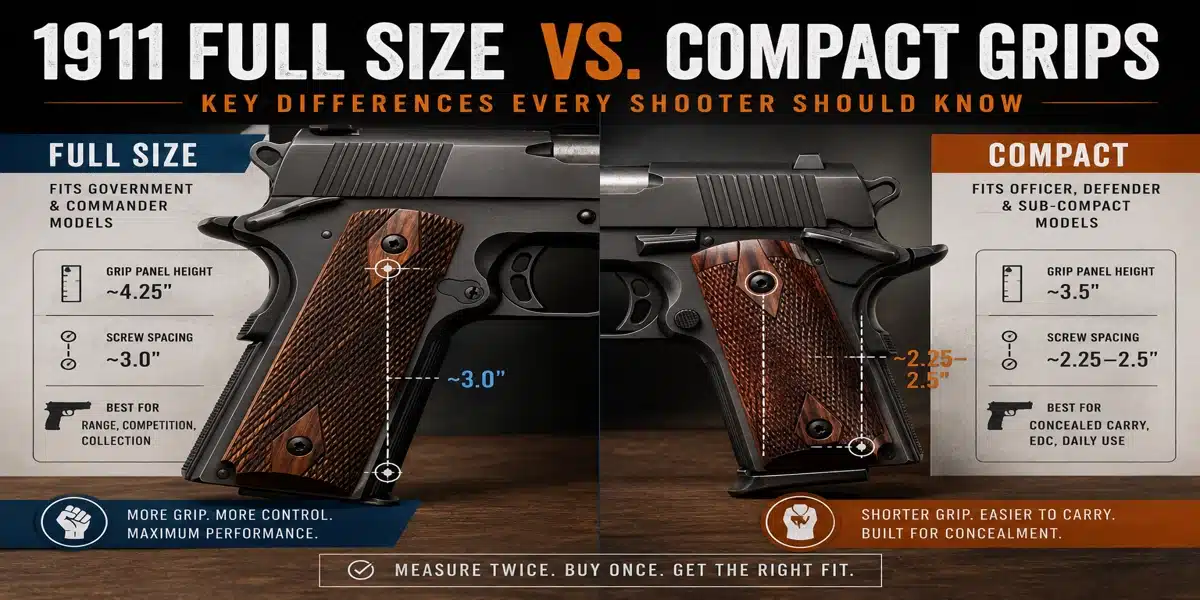
Full size grip panel specs:
- Grip panel height: approximately 4.25 inches
- 1911 grip screw spacing (center to center, vertical): approximately 3-1/16 inches (3.0625″).
- Width: standard single-stack profile
The Officer vs. Government model 1911 comparison starts right here. The Government frame is taller, gives you more surface area for a firm hold, and opens up the widest selection of aftermarket designs on the market. If you’re running a Government Model or a standard Commander, 1911 full size grips are your category, and the options are extensive.
According to CDC:
“Tool handle design, including grip length and diameter, significantly affects muscular force, control, and the risk of repetitive strain.”
What Are Compact 1911 Grips?
Compact grips are built for Officer-size and sub-compact frames, the shorter variants designed for easier carry.
Colt introduced the Officer’s ACP in the 1980s as a carry-optimized version of the 1911. It trimmed the barrel to 3.5 inches and, more importantly, shortened the grip frame. That shorter grip frame is what defines the compact grip category, and it’s what makes 1911 full size vs. compact grips a real fitment issue rather than just a preference conversation.
Compact grip panel specs:
- 1911 grip screw spacing (center to center, vertical): approximately 3-1/16 inches (3.0625″)
- Width: same single-stack profile as full sizee
The reduced grip height means your pinky finger may hang below the bottom of the panel unless the grip includes a finger extension or flared base. That’s a trade-off carry shooters accept willingly, less grip surface in exchange for a shorter, lower-printing profile on the hip.
If you carry an Officer, Defender, or any sub-compact 1911, browse 1911 compact size grips built specifically for your shorter frame. Trying to make a full-size panel work on a compact frame is a losing battle, the math simply doesn’t add up.
1911 Grip Screw Spacing: The Number That Matters Most
If there’s one measurement that determines 1911 grip panel fit, it’s the distance between your two grip screw bushings.
These are the threaded metal inserts in the frame where your grip screws thread in. Measure from the center of the top bushing to the center of the bottom bushing, vertically, and you have the most reliable fitment number available.
- ~3.0 inches → Full size / Government / Commander frame
- ~2.25–2.5 inches → Compact / Officer / Defender frame
Any quality grip panel will list screw hole spacing in the product specs. Match that number to your measurement and you’re done.
This matters even more when you’re shopping for grips on budget 1911 clones where the frame size isn’t always clearly labeled. The screw spacing doesn’t lie, even when the manufacturer’s labeling does.
Full Size vs. Compact: The Shooting Experience Difference
Beyond fitment, the choice between 1911 full size vs. compact grips changes how the gun actually performs in your hands. This is where the comparison gets genuinely useful.
Control And Recoil Management
Full size grips give you more contact surface between your palm and the frame. More surface area means better recoil distribution, less muzzle flip, and more consistent shot-to-shot recovery. For range sessions and competition, the full-size grip frame is simply more comfortable to shoot for extended periods.
Carry Profile
Compact grips reduce the overall footprint of the pistol significantly. The grip is the widest and tallest part of a 1911 when it’s holstered, shortening it reduces printing under clothing, makes IWB carry more comfortable across a full day, and keeps the gun tighter to your body during movement.
Magazine Capacity
A shorter grip frame means a shorter magazine well, which typically means one fewer round. Most Officer-size .45 ACP 1911s hold 6 to 7 rounds versus the Government’s 7 to 8. In 9mm compact 1911s that gap narrows, but the trade-off generally holds across calibers.
Draw Speed Under Stress
Some shooters find the reduced grip surface of a compact frame makes the initial grip acquisition slightly less consistent when drawing quickly. With a full-size frame there’s simply more to grab onto in a hurry. Practice and holster selection can close this gap, but it’s worth knowing going in.
Concealed Carry 1911 Grips: What Actually Works
If you carry a 1911 daily, grip selection goes beyond “what fits” into “what works for this specific mission.”
The best concealed carry 1911 grips share a few characteristics that go beyond frame size:
Thinner panels reduce overall pistol width, which is the main enemy of concealment on any single-stack. Standard thickness grips are fine for range use but add unnecessary bulk for IWB carry.
Smooth or lightly textured outer surface. Aggressive checkering and sharp G10 stippling grab at clothing during draw and re-holster. For concealed carry, a smooth or moderately textured outer surface is more practical than deep tactical texturing.
Durable material that handles daily wear. Your carry grip takes body heat, sweat, and constant friction from holster movement. Wood holds up well for most carriers. G10 is essentially indestructible. ABS plastic is lightweight and practical. Each material has its place depending on your climate and carry style.
A flush, gap-free fit. Any gap between the grip panel and the frame becomes a snag point and a debris trap. For concealed carry 1911 grips, a tight, flush-seated panel isn’t optional, it directly affects your draw when it counts.
Side-by-Side Comparison Table
| Feature | Full Size 1911 Grips | Compact 1911 Grips |
| Frame Compatibility | Government Model, Commander | Officer, Defender, Sub-Compact |
| Barrel Length (typical) | 5″ (Gov) / 4.25″ (Commander) | 3.5″ and shorter |
| Grip Panel Height | ~4.25 inches | ~3.5 inches |
| Screw Hole Spacing | ~3.0 inches | ~2.25–2.5 inches |
| Interchangeable? | No | No |
| Best For | Range, competition, collection | Concealed carry, EDC |
| Grip Surface Area | More, better recoil control | Less, better concealment |
| Full Finger Wrap? | Yes, all four fingers | Pinky may hang below panel |
| Material Options | Full range available | Full range available |
| Aftermarket Selection | Widest available | Strong but narrower |
Mistakes People Make When Choosing Between Full Size and Compact Grips
Buying by brand name instead of frame size. “Kimber 1911 grips” covers both full-size and ultra-compact Kimber models. Always identify the specific frame, not just the manufacturer name.
Assuming Commander means Compact. This is the single most common mistake in the 1911 grip world. The Commander has a shorter barrel but the same grip frame as the Government Model. Commander owners need full-size panels — always. Compact panels won’t reach the bottom of the frame.
Skipping the screw spacing measurement. Looking at photos and eyeballing proportions leads to wrong orders. Two minutes with a ruler or a set of calipers before you buy saves the hassle of a return shipment.
Choosing material before confirming fit. The most beautiful carved rosewood panels in the world are useless if they’re machined for the wrong frame size. Confirm fitment first, then choose your material and finish.
Overlooking grip thickness for carry guns. Both full-size and compact panels come in standard or slim thickness. If you carry concealed, slim panels are worth considering even after you’ve nailed down the frame size match.
How to Pick the Right Set
Step 1:
Identify your frame. Government or Commander → full size. Officer, Defender, or sub-compact → compact. Not sure which you have? Measure your grip screw spacing before buying anything.
Step 2:
Choose based on how you use the gun. Daily carry? Lean toward slim panels in wood, ABS, or compact-cut G10. Range and competition? Standard or oversized full-size panels for maximum surface contact and recoil control. Collector piece? Prioritize material and aesthetics, carved rosewood, pearl, faux mammoth, or faux ivory.
Step 3:
Match material to use case. Wood for classic feel. G10 for performance under pressure. Rubber for heavy recoil. Acrylic and pearl for display.
Step 4:
Confirm hardware is included. Quality grip sets ship with mounting screws. Check the listing before you order so you’re not hunting for grip screws after the package arrives.
Read Also: What 1911 Grips Fit My Pistol?
Get the Right Grip the First Time
The 1911 full size vs. compact grips question has one right answer for your pistol, and now you know how to find it. Frame size determines everything. Screw spacing confirms it. Material and style are yours to choose from there.
At Premium Grips, every listing tells you exactly which frame it fits. No vague descriptions. No ambiguous sizing. Just grips built to drop in and feel right the first time you pick up your pistol; in 290+ designs across rosewood, walnut, G10, pearl, acrylic, faux mammoth, and more.
Whether you’re upgrading your range gun, building out a carry setup, or finishing a collector piece, you’ll find exactly what your frame needs when you Shop custom gun grips, alongside the full range of gun grips for 20+ other handgun brands, all built to the same standard of fit, finish, and craftsmanship.
Frequently Asked Questions
1. What is the main difference between 1911 full size vs. compact grips?
The main difference in 1911 full size vs. compact grips is grip length and frame compatibility. Full size grips fit Government and Commander models and offer better control, while compact grips are designed for Officer-style frames and are shorter for easier concealment.
2. Are 1911 full size grips compatible with compact 1911 pistols?
No. 1911 Full size grips are not compatible with compact or Officer models because the grip frame and 1911 grip screw spacing are different. Using full size grips on a compact pistol will result in improper fitment and misalignment.
3. Which is better for concealed carry 1911 grips: full size or compact?
For concealed carry, concealed carry 1911 grips in compact size are better because they reduce the overall grip length, making the pistol easier to hide and carry daily. Full size grips are better suited for range use and maximum control.
4. How does Officer vs Government model 1911 affect grip selection?
In the Officer vs Government model 1911 comparison, Government models use full size grips, while Officer models require compact grips. This difference directly impacts 1911 grip panel fit and determines whether grips will install correctly on your pistol.
5. Why is 1911 grip screw spacing important when choosing grips?
1911 grip screw spacing determines whether the grip holes align properly with your pistol frame. Full size and compact models have different spacing, so selecting the wrong grip type can cause installation issues or improper fitment.