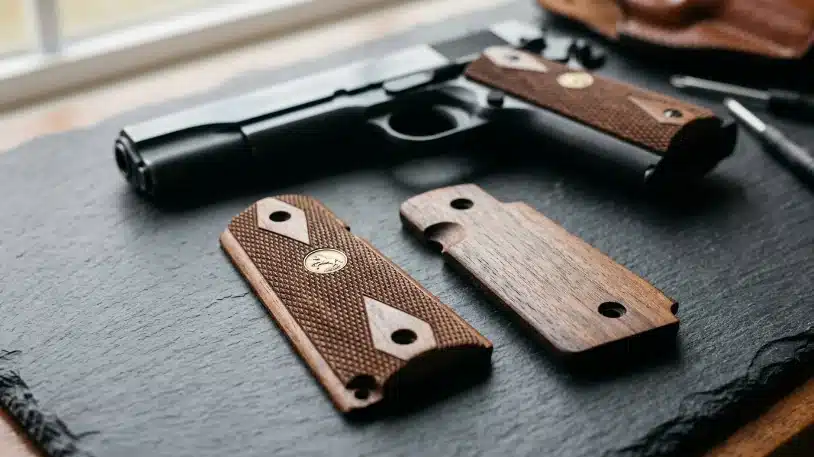
You finally found a set of grips that look absolutely stunning. The wood grain is gorgeous, the finish is clean, and you can already picture them on your pistol. You order them, they arrive in that satisfying packaging, and then… they don’t fit right. The screw holes are off, the grip sits crooked, or even worse; it fits, but the feel is completely wrong for your hand.
It’s one of the most common frustrations in the 1911 world, and it’s almost always avoidable.
Choosing the right 1911 grips isn’t just about finding something that looks good. It’s about understanding your specific pistol’s frame, your hand geometry, and how all the small mechanical details, bushings, grip screws, mainspring housing shape, come together. This guide breaks it all down in plain language so you never waste a purchase again.
Step One: Know Your Frame Size
The 1911 platform has been around for over a century, and in that time it’s been stretched, shrunk, and cloned in every direction. Before you even think about grip style or material, you need to know exactly which frame you’re working with.
Full Size (Government Model)
This is the original, a 5-inch barrel with a full-length frame. It’s the most common platform and has the widest grip selection available. If you own a standard Colt 1911 grips platform or a full-size clone from Springfield, Kimber, or Rock Island, this is your category.
Commander
The Commander has a shorter 4.25-inch barrel but; and this is the key point; it uses the same full-size frame as the Government model. That means the grip area is identical in length and width.
Are 1911 full size vs Commander grips interchangeable? Yes, in almost every case. The grip panels attach to the frame below the slide, and since both models share the same lower frame dimensions, grips made for one will fit the other. This is great news if you own both or plan to upgrade in the future.
Officer / Defender (Compact)
This is where things change. The Officer model uses a shorter frame, typically about three-quarters of an inch shorter grip than the full size. Grips made for a Government or Commander will not fit an Officer model.
The holes won’t line up, and the panel will overhang the bottom of the frame. Always verify whether your compact 1911 takes Officer-size or full-size grips before buying.
When in doubt, measure the distance between your two grip screw holes. Full size and Commander frames measure 3-1/16 inches (3.0625″) between hole centers. Officer frames measure roughly 2.5 inches. Those measurements alone will save you a lot of headaches.
Slim vs Standard 1911 Grips: The Decision That Changes Everything
This is the most important choice most shooters overlook, and it affects both comfort and performance more than any other grip variable.
Standard-Thickness Grips
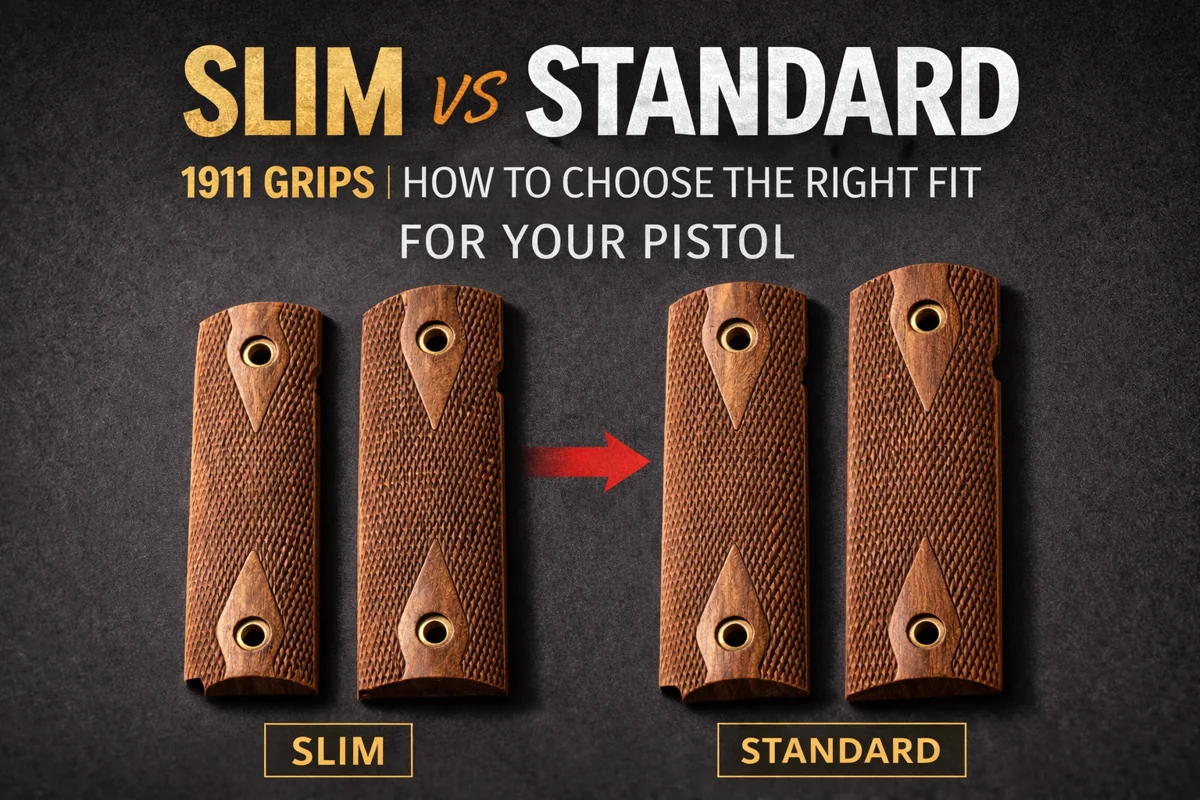
These are what most 1911s ship with from the factory. They give the pistol a fuller, rounded feel in the hand and work well for shooters with medium to large hands. They also tend to look more traditional giving you that classic, substantial 1911 profile.
Slim Grips
Thinner panels, typically around 0.19 to 0.25 inches thick compared to standard grips at 0.35 to 0.45 inches. The difference in overall grip thickness may sound minor on paper, but in your hand it’s dramatic.
When you’re thinking about slim vs standard 1911 grips, consider these factors:
Hand Size
Shooters with smaller or narrower hands almost always shoot better with slim grips. The fingers wrap more naturally around the frame, which improves trigger reach and overall control. Larger-handed shooters may actually find slim grips harder to control because there’s less to hold onto.
Carry Use
If this is a carry gun, slim vs standard 1911 grips comes down to concealment. Slimmer panels reduce printing significantly, especially under a light t-shirt or tucked carry setup.
Ambi Safety Compatibility
Many 1911s are set up with an ambidextrous safety, meaning there’s a thumb safety lever on both sides of the frame. Standard-thickness grips accommodate most ambi safety setups without modification. Slim grips, however, can sometimes interfere with the left-side paddle of an ambi safety, or require a specific cutout to clear it. Always check whether your slim grips are designed with an ambi safety cutout if your pistol is so equipped.
According to National Institute of Justice (U.S. Department of Justice):
“Both semi- and full automatic pistols use the following steps in the examination of the safety features: Check for an external safety device; this should be clearly marked in most pistols.”
The slim vs standard 1911 grips debate doesn’t have a universal answer. It’s about fit to the individual shooter and use case. A competition shooter running a full-size Government model in open class might love thick, textured panels for grip security. A concealed carrier with the same pistol probably wants to go as slim as possible.
Arched vs Flat Mainspring Housing: Why Your Grips Have to Match
This one catches a lot of new 1911 owners off guard. The mainspring housing is the backstrap panel at the base of the grip frame; the curved or flat surface your palm sits against. And here’s what matters for grips: your grip panels need to be designed to match whether your mainspring housing is arched or flat.
1911 arched vs flat mainspring housing grips; what’s the actual difference?
An arched mainspring housing curves outward at the bottom of the grip, pushing the palm upward. Many shooters find this more comfortable and it was the standard configuration on original military-issue 1911s.
A flat mainspring housing is exactly what it sounds like, straight down with no curve. It tends to shift the shooting grip slightly higher and many modern shooters prefer it for a more neutral wrist angle.
Now, why does this affect grip panel fitment? Because the grip panel itself wraps around the lower frame, and some grips are specifically shaped to blend with an arched housing while others are cut for a flat. If you install grips cut for a flat housing on a pistol with an arched housing (or vice versa), you’ll notice a visible gap or a mismatch in the contour line where the grip panel meets the backstrap. It looks wrong, and on wood grips it can actually chip or crack at that junction over time.
When shopping, check whether grips are listed as arched, flat, or fits both. Many panels, especially rectangular or flat-sided designs, are universal. But carved, contoured, or grip-wrap-style panels are often housing-specific.
Grip Thickness, Bushings, and Grip Screws: The Small Parts That Matter
Let’s talk about hardware. This section is short but important.
Grip thickness
It can also influence whether your thumb comfortably reaches controls, particularly the slide stop and magazine release. On a carry gun, every millimeter of added grip thickness changes the concealment equation. Understanding your ideal grip thickness before buying prevents the endless cycle of trying and returning panels.
Bushings
They are the small threaded inserts pressed into the grip frame that your grip screws thread into. They’re easy to overlook, but if your frame’s bushings are damaged, oversized, or missing, no grip will sit flush or tighten properly. Before installing new grips, check that your bushings are clean, undamaged, and properly seated. Replacement bushings are inexpensive and easy to swap.
Grip screws
They come in a few head styles; hex socket, flat-head, and decorative options like polished gold; and in different thread pitches. Standard 1911 grip screws use a 6-48 thread, but some overseas-made clones and budget 1911s use metric threads. Always use the correct thread pitch, and don’t overtighten; wood and acrylic panels can crack under too much torque.
What About Non-Standard 1911 Platforms?
The 1911 pattern has been adopted and modified by dozens of manufacturers beyond the traditional American brands, and not all of them play by the same rules.
If you’re running a Sig Sauer 1911, for example, fitment is generally the same as a standard full-size Government model; but it’s worth double-checking. Sig has produced both full-size and compact 1911-style pistols, and their accessory rail models have slightly different lower frame geometry. Our Sig Sauer grips are listed by specific model to take the guesswork out of compatibility.
If your 1911 has an integral or add-on magwell (a funnel-shaped extension at the base of the grip frame that guides magazine insertion), it will affect grip fitment.
Most full-size grips don’t account for a protruding magwell. Some high-end competition builds have magwells machined into the frame itself, and these require grips cut specifically to clear them. If you’re running a magwell, confirm grip compatibility before purchasing.
How to Measure Your 1911 Before You Buy
Getting a precise measurement before ordering takes about two minutes and saves you the frustration of a misfit. Here’s the quick method for how to measure 1911 grip size:
Screw Hole Center-To-Center Distance
Use a ruler or calipers to measure from the center of the top grip screw hole to the center of the bottom hole. Full size/Commander: 3-1/16″ (3.0625″).
Frame Width
Measure the width of your frame at the grip area. This tells you how much your grip panels need to cover.
Mainspring Housing Shape
Look at the backstrap from the side. If it curves outward at the bottom, it’s arched. If it runs straight down, it’s flat.
Ambi Safety
Check the left side of your frame for a safety lever. If one is present, you’ll need grips with an ambi cutout.
With those four data points, you can narrow your selection confidently.
Installing Your New Grips
Knowing how to install 1911 grips properly is the final step. It’s simple, but doing it wrong can damage your new panels.
Remove the old grips using the correct-sized flat-head or hex key for your grip screws. Set them aside. Clean the frame where the grip panels seat; remove any old debris or dried lubricant.
Place the new grip panel against the frame, align the screw holes, and start the grip screws by hand first to make sure they thread in cleanly. Then tighten with your tool; firm, but not gorilla-tight. Check that the panel sits flush against the frame with no rocking or gaps. Repeat for the other side. Done.
Read Also: Mother of Pearl vs Faux Pearl Grips
Conclusion
Now that you know exactly what you’re looking for; frame size, slim vs standard, arched vs flat, hardware compatibility; you’re ready to find something that actually fits and actually performs.
At Premium Grips, we build for working gun owners. That means real materials (rosewood, walnut, acrylic pearl, G10, rubber), precise fitment, and every order ships complete with the hardware you need.
Whether you’re upgrading your full-size Government model, a Commander carry gun, or something more niche, our catalog covers 1911 platforms and 20+ other brands.
Browse our full selection of pistol grips, filtered by model, material, and style; and find the grip your pistol deserves.
Frequently Asked Questions
Will full-size 1911 grips fit a Commander?
Yes, they will. The Commander shares the same lower frame dimensions as the full-size Government model, so grip panels are fully interchangeable between the two. The shorter barrel and slide don’t affect the grip area at all.
Do I need different screws for slim grips?
No, slim grips use the same standard 6-48 grip screws as standard panels. The difference is only in panel thickness. That said, some slim grips sit closer to the frame, so make sure your screw heads aren’t protruding enough to cause discomfort or interfere with your draw.
How do I know if I need slim or standard grips?
The simplest test is hand size and intended use. If your fingers feel cramped reaching the trigger, or if you’re carrying concealed and noticing printing, slim grips are likely the right call.
Does mainspring housing affect grip choice?
It absolutely does. Grips that are contoured or shaped at the base need to match whether your mainspring housing is arched or flat; otherwise you’ll get a visible gap or misaligned contour where the panel meets the backstrap. Flat-sided or rectangular panels are often universal, but always check the product listing before buying.
Can you use Officer grips on a full-size 1911?
No, officer grips are shorter and the screw holes won’t align with a full-size frame. Forcing them on will leave the bottom of the frame exposed and the fit will be structurally unsound. Officer and full-size frames have different grip lengths, and the panels are not interchangeable in either direction.