How to Choose the Right Material for Gun Grips? A Simple Guide
- teamA-GG
You just bought a new handgun. Or maybe you’ve owned the same 1911 for years. Either way, you pick it up, feel the stock grips, and think… meh. Something’s off. The grip feels cheap. It slides in your palm.
The factory rubber looks dull. And suddenly you’re staring at a screen full of grip options; rosewood, walnut, G10, pearl, rubber, acrylic, wondering which one actually makes sense for your gun and your hands.
Here’s the good news. You don’t need a gunsmith degree to figure this out. You just need to know what each material does, who it’s built for, and what problem it solves.
This guide breaks down how to choose the right material for gun grips in plain English without any fluff or hype. But just the stuff that actually matters when you’re about to drop $35–$50 on a new set of grip panels.
Let’s get into it.
Why Grip Material Matters More Than You Think?
Before we compare materials, let’s get one thing straight: your grip is the only part of the gun your hand actually touches. That means every shot, every draw, every recoil pulse travels through those two little panels first.
How grip affects shooting accuracy isn’t some mystery. A grip that’s too slick shifts in your hand between shots. A grip that’s too aggressive tears up your palm during long range sessions. A grip that fits wrong ruins your trigger press before the bullet even leaves the barrel.
So when people ask how grip affects shooting accuracy on a practical level, the answer is simple. A locked-in, consistent hand position means a consistent sight picture bringing tighter groups. That’s it. Yes, that’s the whole secret.
According to U.S. Army Field Manual FM 3-23.35, Chapter 2:
“A proper grip is one of the most important fundamentals of quick fire. The weapon must become an extension of the hand and arm; it should replace the finger in pointing at an object.”
Now let’s figure out which material gets you there.
The Three Questions You Must Answer First
Before you pick a material, answer these three quick questions:
- How do you use this gun? Daily carry, range gun, competition, or safe-queen collector piece?
- What’s your climate like? Humid summers in Florida feel very different from dry winters in Colorado.
- What matters more, looks or performance? Both are valid. Just be honest.
Your answers shape everything that comes next. This is the foundation of how to choose the right material for gun grips, and skipping this step is why so many folks end up with grips that sit in a drawer.
Breaking Down Every Grip Material
Let’s walk through each option and what it’s actually good at.
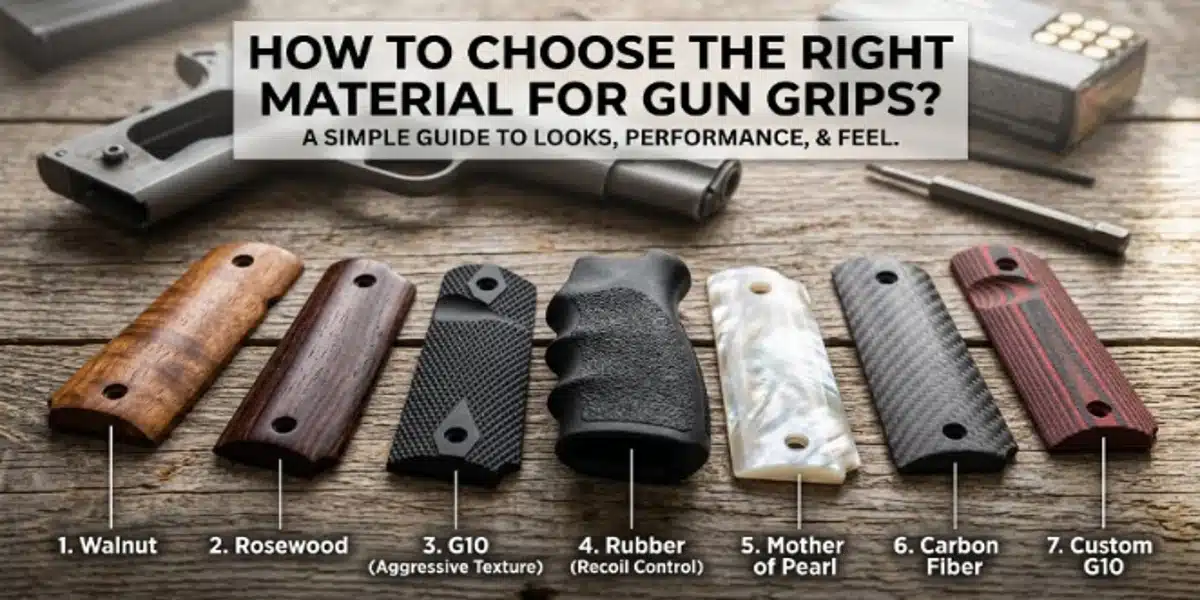
1. Rosewood
Rosewood is dense, heavy, and gorgeous. Deep reddish-brown tones, tight grain, and naturally oily, so it needs less maintenance. On the Janka hardness scale, it ranks 2,700–3,000 lbf, which is roughly three times harder than walnut.
Best For: Collectors, 1911 owners, anyone who wants their gun to turn heads at the range.
Downside: Can feel slippery when wet. Not ideal if you sweat heavy or carry in hot weather.
2. Walnut
Walnut is the OG grip wood. American gunsmiths have used it for over a century, and there’s a reason. It’s lighter than rosewood, has a softer, warmer feel, and shows off beautiful figured grain patterns.
Best For: Traditional revolvers, Heritage Rough Riders, classic 1911 builds, Colt Pythons.
Downside: Softer wood means it can dent if you’re rough with it. Needs slightly more conditioning than rosewood.
3. G10
G10 is a fiberglass-epoxy composite. It’s tough as nails, waterproof, chemical-resistant, and usually comes with an aggressive texture that bites into your hand. It doesn’t care about rain, oil, or sweat.
If you’re looking for the best pistol grip for recoil control, G10 is almost always the answer. The texture gives you a mechanical lock on the gun, which means less slippage when the gun jumps. Serious competitive shooters live on G10 for this exact reason.
Best For: Competition shooters, duty use, anyone who wants the best pistol grip for recoil control on snappy calibers.
Downside: Too aggressive for all-day concealed carry. Your undershirt will pay the price.
4. Rubber
Rubber grips soak up recoil. They’re cushy, quiet, and forgiving. If you have hand pain, arthritis, or just shoot high-recoil rounds like .44 Mag, rubber is your friend.
Rubber is also the go-to non-slip grip for sweaty hands. It grabs your palm even when everything else is soaked. Think summer range days, outdoor matches, or humid climates where wood and steel start slipping.
Best For: High-recoil revolvers, hunting handguns, shooters with sensitive hands.
Downside: Doesn’t look premium, attracts dust and lint.
5. Pearl & Mother of Pearl
Pearl grips (real mother of pearl) and faux pearl (acrylic pearl) are all about looks. Think old-school gambler guns, engraved 1911s, chrome-plated revolvers. The real mother of pearl shimmers with natural rainbow depth. Faux pearl mimics it at a fraction of the cost.
Best For: Display pieces, heirloom guns, collectors who want that classic Hollywood look.
Downside: Not for heavy shooting, pearl is beautiful but brittle, so treat it like jewelry.
6. Acrylic & Faux Ivory
Acrylic grips give you custom colors, patterns, and effects that real wood can’t. Faux ivory delivers that vintage ivory look without the legal or ethical issues of real ivory.
Best For: Custom builds, theme guns, budget-friendly upgrades.
Downside: Less durable than G10 or rosewood. Can crack under heavy impact.
7. ABS
ABS is a tough polymer. Thin, light, and low-profile. If you carry IWB and hate printing, ABS panels keep your draw clean without adding bulk.
Best For: Concealed carry, slim 1911s, backup guns.
Downside: Doesn’t have the soul of wood or the grip of G10.
Read Also: Best 1911 Grips Rosewood, Walnut, G10 & Rubber Compared
Quick Comparison Table: Match Your Material to Your Mission
Here’s the cheat sheet. Print it. Screenshot it. Whatever works.
| Material | Grip Feel | Recoil Control | Best Use Case | Maintenance |
| Rosewood | Smooth, dense | Good | Collectors, 1911s | Low |
| Walnut | Warm, natural | Good | Traditional builds | Moderate |
| G10 | Aggressive, textured | Excellent | Competition, duty | Low |
| Rubber | Soft, cushioned | Excellent | High-recoil, sweaty hands | Low |
| Pearl / Mother of Pearl | Slick, glossy | Fair | Display, collectors | Delicate |
| Acrylic / Faux Ivory | Smooth, glossy | Fair | Custom looks | Low |
| ABS | Light, slim | Fair | Concealed carry | Low |
Match the Material to Your Shooting Style
Let’s get practical. Your shooting style should drive your material choice.
If You’re a Concealed Carrier
You want slim, light, and snag-free. Thin walnut panels or ABS are your friends. Skip aggressive G10, it’ll shred your cover garment. For a printing-sensitive IWB setup, the answer to how to choose the right material for gun grips is always: go slim and smooth.
If You’re a Competitive Shooter
G10 all day. When you’re burning through 300 rounds in a match and your hands are sweating, you need a grip that doesn’t move. G10 gives you that locked-in feel that translates directly into faster splits and tighter groups.
This is also where pistol grip technique for beginners really comes into play, a proper grip starts with a consistent surface, and G10 gives you that reference point every single time.
If You’re a Collector
Rosewood, walnut, or mother of pearl. Pick the one that matches your gun’s personality. A case-hardened Colt wants walnut. A polished stainless S&W 686 wants rosewood. A nickel-plated 1911 Pearl, every time.
If You Shoot Magnums or Big-Bore Calibers
Rubber. Period. Your wrists will thank you after 50 rounds of .357 Magnum. This is also the best pistol grip for recoil control when you’re dealing with snappy, high-energy loads that punish your hand shot after shot.
If You Carry a Glock
Glock factory grips are famously meh. The best Glock grip upgrade for accuracy usually comes from adding a stippled backstrap or a G10-textured wrap, giving you the hand-lock you’re missing from the stock polymer.
While Glocks don’t take traditional panel grips, the principle still holds, texture equals control, and the best Glock grip upgrade for accuracy is almost always about fixing that slick factory feel.
Pistol Grip Technique for Beginners: The Material Connection
Here’s something most new shooters miss. Your grip material and your grip technique work together.
Pistol grip technique for beginners starts with high hand position, firm pressure, and thumbs forward. But if your grip surface is slick acrylic or polished pearl, even perfect technique slips under recoil. On the flip side, if you’re a beginner with a heavily textured G10 grip, you might grip too hard and throw your shots left or right.
For new shooters, walnut or a mild-textured wood is usually the sweet spot. It teaches you proper pressure without punishing mistakes.
Sweaty Hands? Read This.
If you live anywhere hot and humid, like Texas, Florida, the Carolinas, this section is for you.
A non-slip grip for sweaty hands isn’t a luxury. It’s a safety feature. When your palms sweat, smooth wood and polished acrylic turn into ice skates. You lose control, your accuracy tanks, and in a defensive situation, you could literally lose the gun.
The three best choices for a non-slip grip for sweaty hands are: G10 with aggressive texture, rubber with finger grooves, or heavily checkered walnut/rosewood with deep cuts. Avoid pearl, polished acrylic, and smooth ABS if sweat is a constant issue.
Climate and Maintenance: The Long-Term View
Your environment matters more than you think.
- Humid climates: G10 and rubber win. Wood can swell and warp without proper care.
- Dry climates: Wood thrives. Just condition it every few months.
- Cold climates: Rubber and G10 stay consistent. Wood can feel noticeably harder in winter.
- Saltwater or coastal use: G10 is the only material that truly doesn’t care.
Final Decision Framework
Still stuck? Use this simple flow:
- Carrying it daily in hot weather? → G10 or rubber
- Collection piece or show gun? → Rosewood, walnut, or pearl
- Competition or duty? → G10
- High-recoil revolver? → Rubber
- Concealed carry? → ABS or slim walnut and other material used in the blog options
- First upgrade ever? → Checkered walnut. You can’t go wrong.
That’s how to choose the right material for gun grips without overthinking it.
Don’t Forget About Fit
Even the best material on the market is useless if it doesn’t fit your frame. A drop-in fit means no sanding, no gunsmith, no frustration. Every panel you buy should match your exact make and model; 1911 government, Heritage Rough Rider .22, Ruger Wrangler, Smith & Wesson J-frame, whatever you run.
This is why spec-matched grips beat generic “universal” panels every single time.
Ready to Upgrade? Here’s Where to Start
Now that you know how to choose the right material for gun grips, the next step is simple — pick the one that matches your life and pull the trigger on it.
At Premium Grips, we’ve shipped over 50,000 sets to gun owners across America. Every panel is cut for a specific frame, ships with hardware, and installs in under ten minutes with a basic screwdriver. No fitting. No gunsmith visits. No “almost fits” disappointment.
We stock 290+ designs across 20+ handgun brands; rosewood, walnut, G10, rubber, pearl, acrylic, faux ivory, ABS, and more. Whether you need tactical grip panels for your competition Glock upgrade setup, a sweat-proof option for your carry gun, or a jaw-dropping pearl set for your collector’s 1911, we’ve got you covered.
Browse our full collection of custom gun grips and find the set that actually fits your gun, your hand, and your life.
Because your firearm deserves better than a factory.
Frequently Asked Questions
What are the most common materials used for handgun grips?
The most common materials are wood (rosewood and walnut), G10, rubber, pearl, acrylic, faux ivory, and ABS polymer. Each one serves a different purpose, wood and pearl lean toward looks and tradition, while G10 and rubber are built for grip, recoil control, and real-world performance.
Where to buy premium gun grip materials online?
You can shop a full range of premium grip materials directly at Premium Grips (premiumgrips.com), with 290+ designs covering 20+ handgun brands. Every set ships with hardware, offers a drop-in fit, and is backed by 50,000+ units sold across America.
Which gun grip material lasts the longest?
G10 and rosewood are the longest-lasting grip materials you can buy, thanks to their high density and resistance to wear. G10 handles moisture, chemicals, and rough use without flinching, while rosewood’s natural oils help it age beautifully for decades with minimal care.
Do different grip materials affect shooting accuracy?
Yes, grip material directly affects accuracy because it controls how your hand locks onto the gun between shots. Textured materials like G10 and rubber give you a consistent hold under recoil, while smooth materials like pearl or polished acrylic can shift in sweaty or fast-shooting conditions.
We specialize in custom gun grips and manufacture precision grips for 1911 pistols, including Colt grips, Kimber, and Springfield models, plus revolver grips for Ruger, Smith & Wesson, Taurus, Charter Arms, and Heritage Arms grips.
Our collection features premium materials, including rosewood, walnut, acrylic pearl, G10 grips, and rubber. Each grip showcases checkered, carved, or engraved designs with precise fitment.
Built by gun enthusiasts, we deliver quality workmanship at fair prices. At Premium Grips, we help gun owners get a better grip on their firearms. Every order includes all necessary fittings and premium packaging.
We specialize in custom gun grips and manufacture precision grips for 1911 pistols, including Colt grips, Kimber, and Springfield models, plus revolver grips for Ruger, Smith & Wesson, Taurus, Charter Arms, and Heritage Arms grips.
Our collection features premium materials, including rosewood, walnut, acrylic pearl, G10 grips, and rubber. Each grip showcases checkered, carved, or engraved designs with precise fitment.
Built by gun enthusiasts, we deliver quality workmanship at fair prices. At Premium Grips, we help gun owners get a better grip on their firearms. Every order includes all necessary fittings and premium packaging.
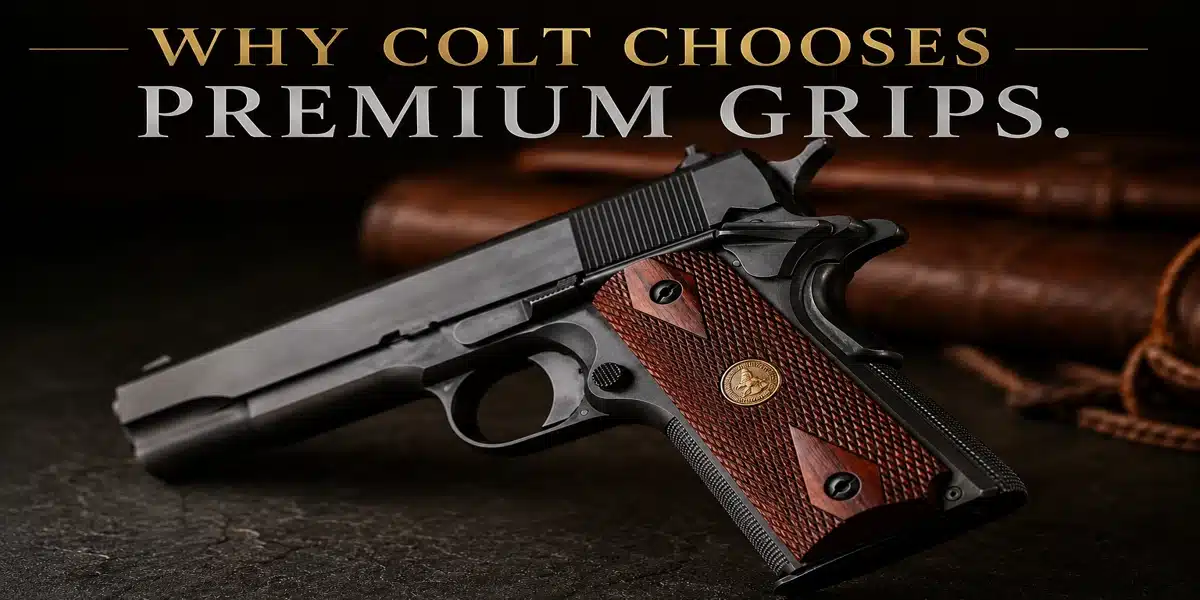
Why Colt Chooses Premium Grips?
By Thomas Pick up a Colt 1911, and your hand finds the
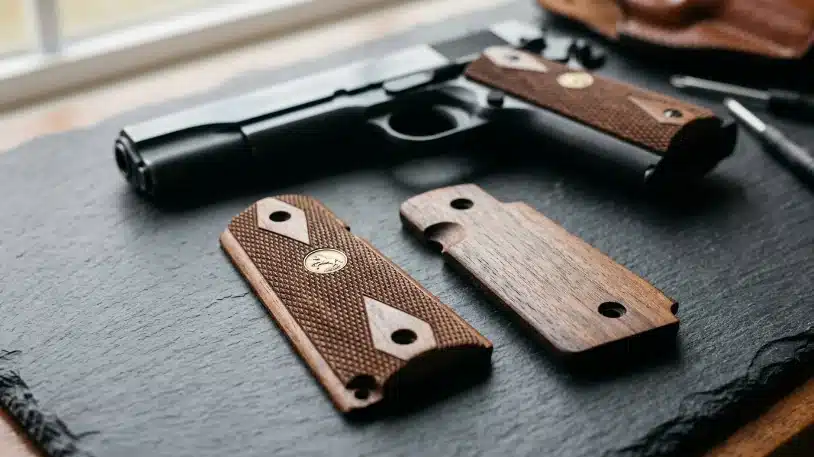
1911 Ambi Safety Grips: Do You Need an Ambi Cut? (Fitment Guide)
If your 1911 has a thumb safety on both sides, you’re shopping
What 1911 Grips Fit Rock Island? Complete Guide
If you own a Rock Island Armory 1911 and you’re staring at
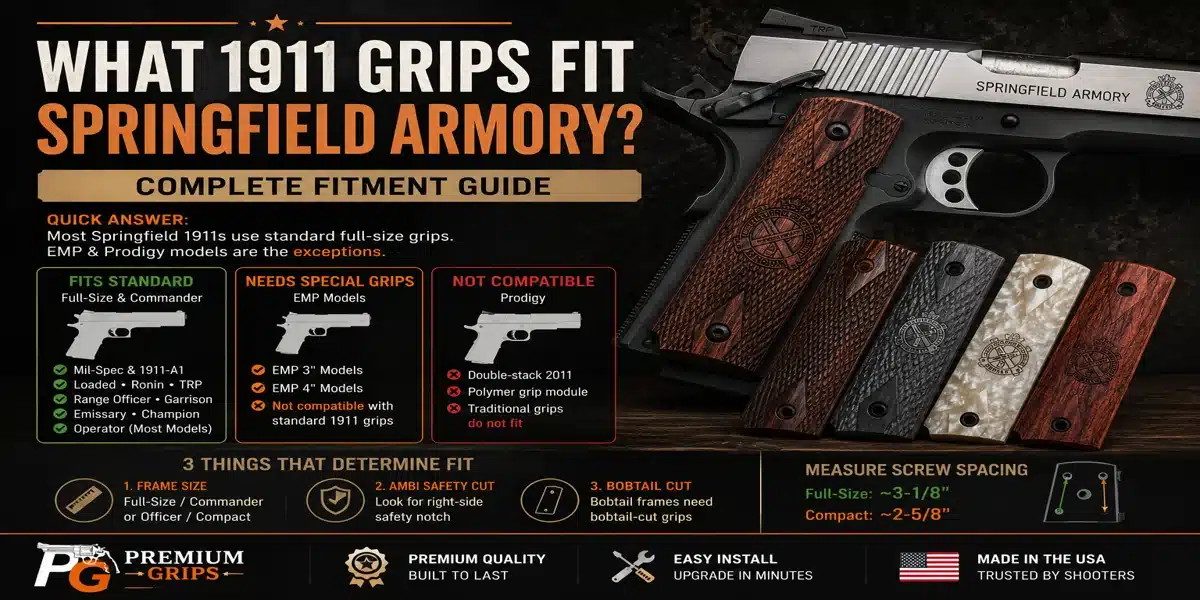
What 1911 Grips Fit Springfield Armory?
Most full-size and Commander-size Springfield 1911s take standard 1911 grips; the same