
There’s nothing quite like the feeling of a .45 ACP going off in your hands. That solid thump, muzzle rise and the way the whole pistol wants to jump.
But most shooters think recoil is something you just deal with, like it’s some unavoidable force of nature you’re supposed to accept.
WRONG.
1911 Recoil Management is a skill, and once you understand how your grip affects every aspect of control, you’ll shoot faster, more accurately, and with way more confidence.
Today, we’re going to break down exactly how to manage that .45 kick through proper technique, the right equipment, and some tricks the competition shooters don’t usually share.
Why Recoil Management Actually Matters?
Every time your muzzle flips high, you waste time bringing it back on target. Every time your grip shifts, you’re making micro-adjustments instead of taking the next shot.
In competition? That’s the difference between winning and watching someone else take home the trophy.
And for defensive use? Those fractions of a second matter even more.
But beyond speed, 1911 recoil control affects:
- Shot placement accuracy
- Fatigue during extended range sessions
- Confidence in your shooting
- Wear and tear on your wrists and hands
- Consistency across multiple magazines
The .45 ACP hits hard but shooters who understand proper recoil management can run through drills all day without their groups opening up or their hands giving out.
The Foundation: Understanding Your Grip
Before we talk about springs, weights, or fancy modifications, we need to address the single biggest factor in controlling recoil.
YOUR HANDS.
Specifically, how you’re using them.
See, most shooters make the same critical error when they first pick up a 1911. They grip it like they’re holding a hammer.
But proper how to hold a 1911 starts with understanding that you’re not just holding the gun. You’re creating a locked, rigid platform that absorbs and redirects energy.
The High Tang Grip: Your Secret Weapon
Here’s where most people lose the battle before the first shot.
They grip too low.
The web of your shooting hand needs to be pressed as high as possible into the beavertail. We’re talking contact so tight you could barely slide a piece of paper between your hand and the grip safety.
Why does this matter for 1911 recoil control?
PHYSICS.
The higher your grip, the more in-line you are with the bore axis. That means less leverage for the recoil and less muzzle flip with faster follow-up shots.
It’s that simple.
But here’s what nobody tells you: getting that high grip consistently takes practice. And it requires proper equipment.
If your 1911 grips are too thick, too slick, or poorly contoured, you’re working against yourself from the start. Your hand won’t naturally find that high position, and when recoil hits, everything shifts.
The Crushing Grip Pressure Test
Now that your hand placement is right, let’s talk about pressure. Most instructors will tell you to grip firmly. But what does that actually mean?
Try this: grip your 1911 as hard as you possibly can. Like you’re trying to squeeze juice out of it. That’s 100%.
For 1911 recoil, you want to be at about 60-70% of maximum squeeze. Firm enough that the gun doesn’t shift. Not so tight that you start shaking.
Your support hand? That’s doing even more work.
Some shooters use an 80/20 split, others go 70/30. But the principle stays the same: your support hand is crushing forward and up, creating a vice grip that locks the pistol in place.
When you get this right, you’ll feel the difference immediately.
Grip Texture: The Overlooked Component
Let’s talk about something most shooters ignore until it’s too late.
And that’s your grip panels.
You can have perfect hand placement and crushing grip pressure, but if your panels are smooth as glass, you’re still going to have problems with the recoil of 1911.
Smooth wood grips might look classy, but they’re working against you. Every shot creates micro-movements. By the end of a magazine, your grip has shifted enough that you’re fighting to maintain control. This is why serious shooters choose aggressive textures.
We’ve written an entire guide on 1911 grip texture because the choice between checkering, aggressive patterns, and smooth finishes affects everything from comfort to control.
The Role of Hand Size in Recoil Control
Here’s something that doesn’t get talked about enough. Not everyone’s hands are the same size.
Revolutionary insight, right?
But seriously, how hand size affects your 1911 grip is crucial to understanding why some shooters naturally handle recoil better than others.
If you have large hands and thin grip panels, you might be able to get an aggressive hold. But you also might be feeling too much of the frame’s sharp edges digging into your palm.
Small hands with thick grips? You can’t get your fingers around far enough. Your trigger reach is off and your leverage is compromised.
Beyond Technique: Equipment Solutions
Alright, we’ve covered the fundamentals of grip. Now let’s talk about hardware. Because while technique is king, the right equipment makes 1911 recoil control significantly easier.
Recoil Springs and Systems
The recoil spring for .45 ACP does exactly what it sounds like: it controls how fast the slide returns to battery after each shot.
Factory springs are designed for reliability across a wide range of ammunition. But they’re not optimized for any specific load or shooting style.
Heavier recoil springs slow down the slide’s rearward velocity. This can reduce felt recoil and make the gun feel softer. But go too heavy and you’ll run into reliability issues, especially with lighter loads.
When Equipment Becomes a Crutch
Let me be straight with you. No amount of fancy recoil systems will fix a bad grip.
I’ve seen shooters drop serious money on custom recoil reducers, heavier springs, and compensators… only to still struggle with muzzle flip because their fundamentals are wrong.
Get your grip right first, master the technique, and then if you want to fine-tune with equipment, you’ll actually see the benefits.
Competition-Level Grip Techniques
Now we’re getting into the advanced stuff.
If you want to shoot a 1911 at competition speed while maintaining control, you need more than just grip it and rip it.
Competition shooters use specific techniques for how to grip a 1911 for competition shooting that maximize speed without sacrificing accuracy.
The thumb-forward technique, for example, puts both thumbs pointed at the target, pressed against the frame. This creates additional forward pressure and helps manage recoil through the support hand.
The key is consistency. Your grip on shot one should be identical to your grip on shot fifteen.
The Grip Safety Factor
Here’s something specific to the 1911 platform that affects everything we’ve talked about: the grip safety.
For proper 1911 recoil management, your 1911 grip safety needs to be fully depressed on every shot. If your grip is too low or if your hand shifts during recoil, you can partially release the grip safety.
That creates inconsistency. Sometimes the trigger works, and sometimes doesn’t.
This is another reason why that high tang grip is so critical. It ensures complete, consistent engagement of the safety mechanism while simultaneously putting you in the best position to manage recoil.
Training Drills for Better Recoil Control
Knowing what to do is one thing, and building muscle memory is another.
Here are simple drills that will improve your 1911 Recoil Management faster than anything else:
The Penny Drill
Balance a penny on your front sight. Dry fire without dropping it. This teaches you to manage trigger press without disturbing your sight picture.
Slow Fire Groups
Five shots at 25 yards, as slow as you need. Focus entirely on maintaining your grip through the entire recoil cycle. Watch for any shift or loosening.
Rapid Fire Recovery
Start with one shot, master the recovery. Add a second shot, master that transition. Build up to five-shot strings where every shot feels identical.
Grip Pressure Check
Every five shots, stop and evaluate. Observe if your grip pressure changes, or your hand position shifts If yes, reset and figure out why.
Common Mistakes That Kill Recoil Control
Let’s talk about what NOT to do.
Mistake #1: The Teacup Grip
Supporting hand underneath the magazine? That’s doing nothing for recoil control. You need side-to-side pressure, not bottom support.
Mistake #2: Death Grip
Squeezing so hard you shake? You’re wasting energy and creating tension that actually makes recoil worse.
Mistake #3: Inconsistent Pressure
Your grip on the first shot should match your grip on the last. If you’re loosening up as you shoot, you’re losing control.
Mistake #4: Ignoring the Weak Hand
Your support hand does MORE work than your shooting hand when it comes to recoil management. Stop treating it like an afterthought.
Mistake #5: Wrong Equipment
Slick grips, worn-out recoil springs, or parts that don’t fit your hand size all work against your practice. You need to fix the hardware here first.
The Temperature and Environment Factor
Your grip effectiveness changes with conditions.
Sweaty hands in summer? You need a more aggressive texture.
Cold weather with gloves? Your grip panels better have deep enough checkering to work through fabric.
High round count on a hot day? Fatigue sets in faster and your grip pressure drops.
Smart shooters account for this. They practice in different conditions. They know how their equipment performs when things aren’t perfect.
Why Proper Grips Matter More Than You Think?
We’ve talked a lot about technique. And technique is absolutely the foundation.
But here’s the reality: your best 1911 grips for better control act as the interface between all that technique and the firearm itself.
Quality grips enhance everything you’re doing right. They help maintain that high tang position. They provide the friction necessary for crushing grip pressure.
It’s not just about looks or tradition, it’s all about function.
And function directly impacts your ability to manage recoil shot after shot, magazine after magazine.
Putting It All Together
1911 recoil management is not some secret technique that only professional shooters understand.
It’s fundamentals:
- High tang grip placement
- Proper grip pressure distribution
- Aggressive texture for traction
- Consistent technique across every shot
- Equipment that fits your needs
Master these basics and the .45 ACP becomes manageable. The difference between a shooter who handles recoil well and one who doesn’t usually comes down to intentional practice and the right tools for the job.
Upgrade Your Control Today
Look, we’ve spent 2000 words talking about grip, technique, and control.
But if your current gun grips are working against you, all the techniques in the world won’t fix the problem completely.
This is where Premium Grips makes a difference for working shooters who want real performance improvement.
We manufacture custom 1911 grips, designed specifically for shooters who prioritize function over flash. Every set is precision-fit, made from materials chosen for traction and durability, and built to help you achieve that perfect grip every single time.
Ready to feel the difference?
Check out our 1911 grip collection and find the perfect fit for your shooting needs. Every set comes complete with all necessary hardware and premium packaging, ready to install and improve your control immediately.
Read Also: 7 Common 1911 Grip Mistakes (And How to Fix Them Fast)
Frequently Asked Questions
Why do 1911s jam so much?
Actually, well-maintained 1911s don’t jam that much, that’s mostly a myth from cheap copies or worn-out guns. The platform has tight tolerances that require proper maintenance and quality magazines.
Does a 1911 have a lot of recoil?
The .45 ACP has a solid push rather than a sharp snap, it’s manageable recoil, not punishing. Compared to lighter polymer pistols, the 1911’s all-steel construction actually helps absorb energy, making it feel softer than you’d expect.
Can a compensator reduce recoil?
Yes, compensators redirect gas upward to counteract muzzle rise, keeping your sights flatter between shots. They’re popular in competition shooting where speed matters, though they add weight and length to the gun.
Why did the U.S. military stop using the 1911?
The military switched to the Beretta M9 in 1985 primarily for magazine capacity, 15 rounds versus the 1911’s 7 or 8 rounds. NATO standardization pressure and the lower cost of 9mm ammunition also played roles.
Related Posts
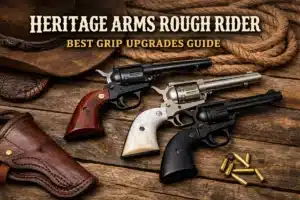
Heritage Arms Rough Rider — Best Grip Upgrades Guide
You already own one of the most iconic single-action revolvers ever made. The Heritage Arms…
Read More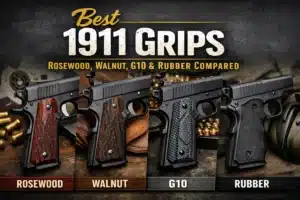
Best 1911 Grips Rosewood, Walnut, G10 & Rubber Compared
Your 1911 deserves better than the factory grips it came with. Whether you’ve had your…
Read More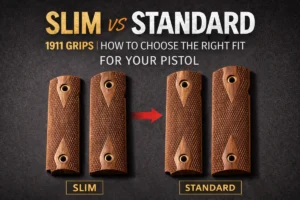
Slim vs Standard 1911 Grips: How to Choose the Right Fit for Your Pistol
You finally found a set of grips that look absolutely stunning. The wood grain is…
Read More